Every few weeks, a founder shows me the same screenshot. It is a content calendar built after a weekend binge of Alex Hormozi videos: posts every day, outreach every morning, a podcast, a newsletter, LinkedIn, X, TikTok. Six weeks later, the calendar is empty and the founder is convinced that content does not work for his company.
I have watched this movie with more than fifty founders and business owners since 2023, in AI, in SaaS, in e-commerce, and on my own accounts. The advice was right. The dosage killed it. This essay is the story of how I learned to dose it, and the handbook I now give to AI founders in San Francisco who want short-form content at scale without a full-time content team, and without giving up the company they are building. The chapters are summarized in the Creative-Led Growth Handbook on statur.co, and your AI can run them with the open-source statur-creative-led-growth skill from my cookbook on GitHub.
TL;DR
- Hustle advice works for people whose job is content. Founders who copy it burn out, see few results and quit.
- Choose one primary channel for your KPIs. Every other channel only distributes.
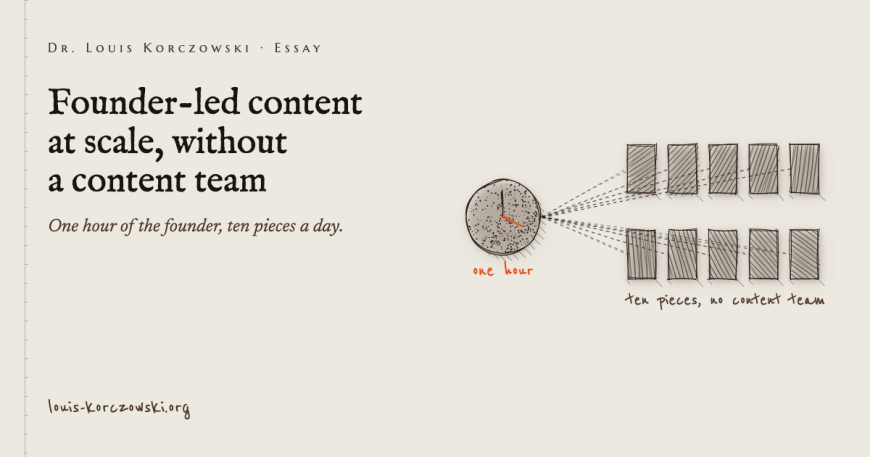
- Give it one hour of founder brain a day and aim for five to ten pieces in that hour. The hour is the scarce resource, so the system is built around it.
- Your best ideas look like coal to you. Someone has to find the diamonds and package them with mass psychology.
- Judge a video by who shares it. Three months give you 200 to 300 data points, and your organic winners become your cheapest ads.
The advice is right, and it breaks founders
Hormozi’s Rule of 100, from $100M Leads, asks for one hundred primary actions every day: one hundred messages, one hundred calls, or one hundred minutes of content. Paul Graham said the same thing to founders in 2013 in Do Things That Don’t Scale: “You can’t wait for users to come to you.” I agree with both of them. Distribution is work, and somebody has to do it every day.
The problem is who reads that advice. A technical founder before Series A is building the product, raising money, hiring, closing the first customers and answering investors. He usually has no video editor, no analyst, no community manager, and maybe an intern. When he adds four hours of content and prospecting on top of that, he does what any athlete does when he starts a marathon plan at the volume of a professional: he gets tired, he gets injured, and he learns nothing. In endurance sport, the body only adapts to the load it can absorb. Marketing works the same way for a small team. Volume without the capacity to analyze it produces exhaustion and no learning.
Why distribution became the founder’s job
Peter Thiel wrote in Zero to One that “superior sales and distribution by itself can create a monopoly, even with no product differentiation.” In 2014 that sounded like a sales slogan. In 2026, with AI shipping products in a weekend, it describes the market every founder lives in. When building is cheap, attention and trust become the scarce assets.
Cluely is the loudest proof of it. Roy Lee turned an interview-cheating tool into a company that raised a $5.3 million seed and a $15 million round led by Andreessen Horowitz in 2025, almost entirely on viral distribution. The company reportedly pays more than sixty content creators and seven hundred video editors. In a16z’s announcement, the investors credit the growth team for “impressive brand awareness and mindshare”. At TechCrunch Disrupt, Lee told founders that “if you’re any good at engineering, you’re probably not funny”, and that outside deep tech you need to “low-key deep focus on distribution.”
He is half right, and the other half matters. On the same stage, Lee admitted that “maybe we launched too early”, and in March 2026 he retracted a revenue figure he had given to the press. Attention bought with provocation and an army of creators is borrowed. Attention earned by a founder’s real ideas compounds. Most AI founders cannot hire seven hundred editors. What they can build is a system that turns their own thinking into distribution at a dose they can sustain.
Rule 1: one primary channel, everything else distributes
In marketing, the number of possible combinations is close to infinite: Google Ads, Meta Ads, organic content, LinkedIn prospecting, cold calls, events, partnerships. Senior teams can test several channels at once because each channel has its own specialists. A founder who tests everything learns nothing, because every channel needs different skills, different people and a different rhythm. Doing everything is the best way to do nothing.
So the first decision of the handbook is the most important one: choose one primary channel. It is the only channel where you track KPIs, read the data and make decisions. Every other channel is secondary. You publish there to distribute and amplify the message, and you do not track it precisely.
Gary Vaynerchuk popularized a version of this with his pillar model, where one long piece of content becomes dozens of micro pieces and the goal is to “create more content than you ever thought possible.” My version starts from the same repurposing logic with a different pillar. The pillar is one hour of the founder’s brain, shot directly in the format of the primary channel. A video made for TikTok goes to Instagram Reels, YouTube Shorts, Facebook Reels, Snapchat and LinkedIn video. AI can turn the same ideas into a technical blog post or a LinkedIn text. AI repurposes your ideas, and the ideas themselves stay yours.
Which channel? For most founders I work with today, organic short-form video is where the arbitrage sits. Distribution is cheap, niche content works, and a video with 200 views can still bring a client. The learning phase is cheap too: you can publish ten or twenty pieces a day without paying for each test, while an ad account needs enough budget per creative before Meta’s algorithm learns anything. And TikTok is no longer a teenage app. According to Pew Research, 37% of US adults used it in 2025, including 44% of adults aged 30 to 49. Very few B2B companies dare to make it their primary channel, which leaves a boulevard for the ones who do. Choosing a channel that is slightly suboptimal still teaches you more than spreading yourself over five.
Rule 2: one hour, five to ten pieces
Here is the constraint the whole method is built around. The founder’s brain is the only part of the system nobody can replace. A video editor can be hired, a scheduler can be automated, distribution can be delegated. The vision, the technical depth and the conviction of the person who builds the product cannot.
So I protect that hour like a scarce resource. In one hour of founder time, a trained team aims for five to ten unique pieces of content on the primary channel. The arithmetic is simple and brutal: sixty minutes, so about five to ten minutes per piece, and then the next one. That only works when everything around the founder is prepared: the topics, the hooks, the formats and the order of the shoot. The founder talks, and the system does the rest. Voilà.
David Ogilvy put the stakes of this hour in one line: “In the modern world of business, it is useless to be a creative, original thinker unless you can also sell what you create.” The hour is where the founder’s thinking becomes something that sells.
Rule 3: find the diamonds in the coal
Founders swim in their own ideas. They have hundreds of them, and they are never sure which ones are good. To them, most of it looks like coal. The job of a creative strategist is to find the diamonds, understand them and format them so that anyone can understand them.
I recently worked with a founder who builds a video editing tool. He told me his idea in product language: founders spend too much time editing their videos, so they stop making content, and his tool fixes that. It is a good product. Nobody will watch a video that says “I built a video editor.”
When I listened longer, a stronger idea came out. Social media is full of people with nothing to say, and he is disgusted that the people who build incredible things are the ones nobody hears. His frustration is that the smartest people of our time lose the attention war to the loudest. That is an idea people share. The product is how he fights for it. The mission is what makes people listen.
Rule 4: package the idea for crowds
A diamond still needs a cut. The second step is packaging: making the idea interesting for social media, using the principles of mass psychology that the French psychologist Gustave Le Bon started to describe in The Crowd in 1895.
Three principles do most of the work, and a century of research backs each of them.
The negativity bias makes a threat or a mistake travel faster than good news. Roy Baumeister and his colleagues reviewed decades of studies in a paper whose title says it all, Bad Is Stronger Than Good (2001): across relationships, money, learning and memory, bad events weigh more than good ones of the same size.
The knowledge gap opens a question in the first seconds that only the end of the video answers. George Loewenstein described curiosity in 1994 as “a form of cognitively induced deprivation that arises from the perception of a gap in knowledge or understanding.” Twenty years later, the neuroscience caught up. Matthias Gruber, Bernard Gelman and Charan Ranganath showed in Neuron that a curious brain activates its dopamine reward circuit and its hippocampus, and remembers better, even the unrelated information shown while it waits for the answer. A good knowledge gap does more than hold attention. It makes your idea stick.
Emotion decides what gets shared. Jonah Berger and Katherine Milkman analyzed 6,956 New York Times articles and found that “content that evokes high-arousal emotions (i.e., awe, anger, and anxiety), regardless of their valence, is more viral.” Calm content gets read, and content that moves people gets forwarded.
Storytelling with a twist synchronizes brains. Greg Stephens, Lauren Silbert and Uri Hasson recorded the brains of a speaker and of listeners, and found that their activity couples during a story: “the greater the anticipatory speaker-listener coupling, the greater the understanding.” I spent ten years recording several brains at the same time in my own research, and this is the result I find most useful for founders. When your audience starts predicting where your story goes, they understand you.
With these principles we build a library of hooks for each idea, which in practice looks like a list of topics to cover.
Each topic then gets a format: an angry facecam reacting to the news, a tier list, a reaction to a viral video, a founder story. A format is a repeatable shape, so the team can shoot it again without thinking. That is what makes one hour enough. I explain how we pick formats and judge them over many posts in the dice system.
Rule 5: read who shares
Views are a vanity metric for a founder. They are worth reading, and they are rarely the one that matters. The metric I watch first is the share rate.
Imagine a very niche video for people who work in the metallurgy industry. It gets 200 views and 2 shares. Those two shares probably went to colleagues in the same industry, which makes them high-value signals and potential leads. Another video gets 20,000 views and no shares. People watched, maybe they enjoyed it, and nothing happened. TikTok itself lists shares among the interactions that drive recommendations, and states that “neither follower count nor whether the account has had previous high-performing videos are direct factors” in its system. A founder with zero followers can reach the right niche on his first day if the idea is packaged for it.
Then come the metrics further down the funnel. You need a way to collect leads, through DMs or a form, and a positive feedback loop with sales. Ask your sales team to add one question to every discovery call: how did you find us, and which video put you in motion? Claude Hopkins wrote in 1923 that “almost any questions can be answered, cheaply, quickly and finally, by a test campaign.” A hundred years later, a feed is the cheapest test campaign ever built, as long as somebody reads it. I described that weekly reading, with AI doing the heavy lifting, in What David Ogilvy Would Do With TikTok Analytics, and the routine is written step by step in the Content Testing Loop.
What three months give you
If you follow these rules, three months give you 200 to 300 pieces of content, setup included. That is the strict minimum. It is also 200 to 300 data points, probably leads and meetings, and the first clients who amplify you.
Start with monthly cycles: produce, publish, read, replace what does not work. As you staff your marketing team, the cycles get shorter, and the founder can move to two days a week of content production supported by the team. In my experience, most of the companies I work with reach a position of reference in their niche faster than with any other method, and with budgets far smaller than ads alone would need.
And this is only the first step. The best formats and the best organic videos become your cheapest ads, because they have already proven themselves with real people. Here is how a winner moves from organic to paid. They also open doors that ads never open: partners, hires, investors and journalists who already know your ideas before the first meeting.
The objection I hear most
“Isn’t this just volume, like Cluely?” Volume is the instrument, and the ideas are the music. Cluely proved that distribution can make a company famous. It also showed that attention without substance runs out. The handbook asks for less volume than the hustle gurus, and more thinking per minute.
I also tell every founder the same thing on day one. Some videos will do two thousand views. Statistically, some will do hundreds of thousands. Then millions. I guarantee the system and the volume. The platform decides the timing. The method behind this handbook has generated 400M+ organic views for clients in two years (last count, January 2026), and I still cannot tell you which video will be the one.
So here is my question for you. If you had only one hour a day for content, which idea would you protect first?
The founders who last give content one hour a day and build a whole system to multiply it.
FAQ
What is creative-led growth?
A growth model where the founder’s ideas and the content built from them become the main acquisition channel. Sales-led growth came first, then product-led growth. When AI makes products easy to build and copy, the ideas and the people in front of the camera decide the growth.
How much time does founder-led content take?
In this method, one hour of founder time a day, aimed at five to ten pieces of content. Everything else, from topics and formats to editing, distribution and analysis, is prepared around that hour.
Which channel should a B2B AI startup choose first?
One primary channel where you track KPIs. For most early-stage founders today, organic short-form video offers the cheapest learning and distribution. Other channels only redistribute the same content.
Which metric matters most for founder content?
The share rate, read together with leads and the answers to “how did you find us” in sales calls. A niche video with few views and a few shares can be worth more than a broad video with many views and no shares.
Annex: the original video
The short video where I first described this method.
Dr. Louis Korczowski is a short-form content strategist for SaaS and AI founders and the author of the Creative-Led Growth Handbook at STATUR and of the open-source Content Strategist AI Cookbook on GitHub.