In October 2026, on My First Million, Shaan Puri, Sam Parr and their guest Ben Levy read a post from Pieter Levels on air. Levels is the solo developer who runs a portfolio of products from his laptop, and he pivoted to AI apps back in 2022. Now, he wrote, he is scrambling to chase the moats that remain, because he expects AI companies to suck up everything else. The hosts spent the next minutes ranking his list.
I have a stake in this question. I did a PhD in machine learning and neuroscience, spent ten years in brain-computer interface research, and then went to the other side: growth, content and distribution for startups. I watched good products die because nobody heard about them, and average products win because everybody did. So when Silicon Valley starts asking what an AI moat even is, I want to answer with the people who shaped the debate, and then with what I see every week in the feeds.
TL;DR
- When AI can rebuild a product in weeks, the code stops being a moat. Levels keeps six: data or content, network effects, audience and distribution, physical assets, capital and regulation.
- Distribution was already the hard part before AI. Peter Thiel, Alex Rampell and Justin Kan said it years ago. AI makes their point sharper.
- Every channel gets more expensive as it gets crowded: Meta’s price per ad rose 14% in Q3 2026, and AI slop now fills a large share of short-form feeds.
- The frontier labs and the biggest funds are buying distribution themselves. OpenAI bought a talk show, a16z runs a media team.
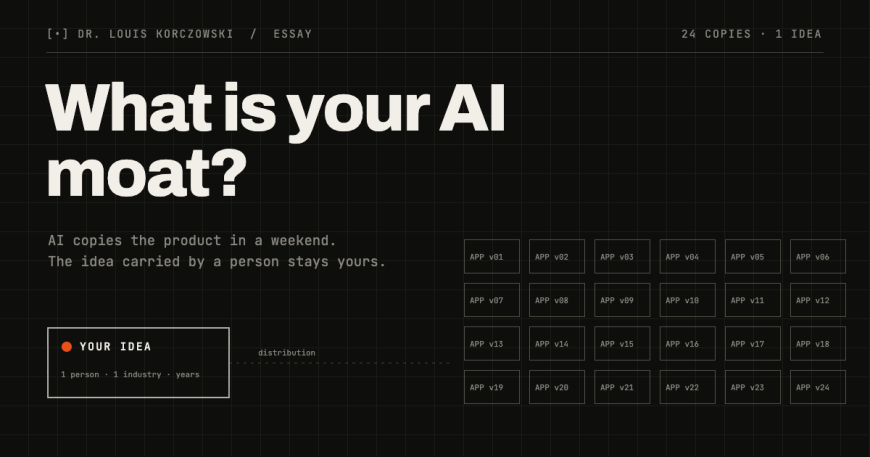
- My bet: building distribution and keeping it will be the biggest challenge of the next decade, and it will take more creativity every year. An idea carried by a real person is the part nobody can copy.
The moats that survive AI, according to Silicon Valley
Levels published his list in October 2026: proprietary data or content, network effects or community, audience or distribution, a physical component, capital, and regulation. For distribution, his definition is simple and I love it: you “can get attention on demand”. He also explained how he works on it himself. His X audience pays him, and he diversified into an email and Telegram list of more than 185,000 people who receive digests of his posts (levels.io).
On the podcast, the hosts pushed back a little (My First Million, October 23, 2026, segment at 20:10). Network effects came out on top for them, with the classic examples of marketplaces that people use because everyone else is already there, even when the product is mediocre. Brand came up as a candidate too. One of the hosts gave the rule I would keep from the whole segment: build where AI makes the core of your work easier and cannot do the core itself.
What strikes me is the shape of the list. Two of his six moats are about people: a community and an audience. The software itself is gone from the list.
Distribution was always the hard part
None of this is new. In Zero to One (2014), Peter Thiel wrote that “poor sales rather than bad product is the most common cause of failure”, and that if you can get just one distribution channel to work, you have a great business. In 2018, Justin Kan tweeted that first-time founders are obsessed with product and second-time founders with distribution (discussed on OpenView’s BUILD podcast). Every founder I know who has failed once repeats it.
The sharpest version comes from Alex Rampell at a16z in 2015: “The battle between every startup and incumbent comes down to whether the startup gets distribution before the incumbent gets innovation.“
AI shortens the innovation side of that race for everyone. The incumbent adds an AI feature to a product its customers already pay for. Ten startups ship the same idea in the same month. Andrew Chen, also at a16z, wrote in February 2025 that in a world of “GPT wrappers”, network effects and distribution will be king, once more. His colleague Bryan Kim went further for consumer AI in June 2025: momentum is the moat, and “whoever builds first, iterates fastest, and distributes best wins”.
Sam Altman gave the founders’ version of the same warning on 20VC in April 2024. If your startup patches a weakness of today’s models, OpenAI will steamroll you as it improves its models. Build so that a better model makes your product better. I would add the corollary he left out: every better model also makes your product cheaper to copy, so the moat has to live somewhere the model cannot improve for your competitors.
Why distribution gets harder, channel by channel
Here is the paradox I see with every client. Launching an ad campaign, a YouTube channel or a short-form account has never been technically easier. And reaching people has never cost more. Both facts have the same cause: everybody jumped in.
Paid ads. When I started in performance marketing, a good creative and a bit of targeting could carry a launch. Today Meta reports its average price per ad up 14% year over year in Q3 2026, after 10% the year before (Meta Q3 2026 results, 10-Q), and 23% in the US and Canada according to its earnings deck. Nearly 10 million advertisers used Meta’s generative AI tools to make ads that quarter (Adweek). On Google, cost per click rose in 87% of industries in WordStream’s 2025 benchmark (Search Engine Land). Some startups now go as far as renting the X timeline for a day with paid viral launches. Andrew Chen has a name for this decay, the law of shitty clickthroughs, and in April 2025 he titled an essay Every marketing channel sucks right now.
YouTube. Long-form YouTube professionalized. The channels that win in a niche now run like small studios, with writers, editors, thumbnail designers and research. A founder who opens a channel today competes with teams, and the bar for a first video that anyone watches went up every year. That is my reading of the market from the inside, d’accord, and I think every creator who started after 2020 will confirm it.
Short-form. This is where the volume exploded, and where the change is the most brutal. Kapwing opened a fresh YouTube account and found that 21% of the first 500 Shorts it was shown were AI slop, and a third were brainrot. On TikTok, the same test in 2026 gave 59%. The feed is drowning in content that is cheap to make and badly made.
You could read this as bad news for anyone who wants to build an audience. I read it the other way. If your content is generic, you compete with an infinite supply of generic content produced at zero cost, and you lose. If your content carries an idea that only you have, the flood makes you easier to spot. An AI can produce a thousand videos about productivity tips tonight. It cannot produce your opinion on where your industry is going, the customer story that made you rebuild your product, or the argument you had with your investors last Tuesday.
The labs and the funds are buying distribution
Watch what the most informed money does. In April 2026, OpenAI bought TBPN, the daily live tech show hosted by John Coogan and Jordi Hays (Axios). It was OpenAI’s first media acquisition (Business Today). Sam Altman called it his favorite tech show. The company that builds the frontier model decided it also needed a place where the conversation happens.
Andreessen Horowitz went the same way with its New Media team, which it describes as “go-direct as a service” for startups. Their 2026 manifesto puts the rule in one line: “to win you must go direct, and to go direct you must be interesting“. The same text puts it bluntly: “people confer signal, not brands”. When the firm co-founded by the man who wrote “software is eating the world” builds a media operation for its founders, the message is clear enough.
Brand is what’s left
Paul Graham wrote the theory of this moment in March 2026, in an essay about Swiss watches: “Brand is what’s left when the substantive differences between products disappear.” And making those differences disappear, he adds, is what technology naturally does. Quartz made every watch accurate. AI is making every app, every landing page and every ad decent.
Graham is wary of the brand age. His conclusion tells smart people to stay away from brand and to follow the problems, because pushing people’s brand buttons is a poor problem to work on. I agree with the second half, and it is exactly the kind of brand I care about: a founder associated with an industry or an idea is someone following a problem in public. That brand stays close to substance, because the founder has to defend the idea every week. When the idea is wrong, the comments tell him within 48 hours.
“You are the niche” has a part of truth
The “you are the niche” movement says that your personality is your positioning. It comes from a real insight. Naval Ravikant put it this way in 2019: “No one can compete with you on being you.” If you build and market something that is an extension of who you are, nobody can copy it.
The problem is how people apply it. Many creators read it as permission to post about everything they like: fitness on Monday, AI on Tuesday, their holidays on Wednesday. The audience cannot say what they stand for, and the algorithm cannot either. The niche is the intersection of you and one industry, or you and one idea, repeated long enough that people think of your name when the topic comes up. Levels is the perfect example: the person is everywhere, and the topic is always the same, building small internet businesses alone.
Why it will take more creativity every year
So here is my position, and it is the reason I do this job.
Building distribution and keeping it will be the biggest challenge for startups in the AI era. It will require a lot of creativity, and the ways to get there will get harder every year. Every format that works gets copied, then saturated, then ignored. Every channel follows Chen’s law. The founders who win will be the ones who keep inventing the next format before the current one wears out, and who know when to persevere with an idea and when to kill it. That judgment is the real moat, and it compounds.
With my clients I treat each format as a die we throw every week. We read the data, keep the winners, iterate the rest, and look for the next die before the current one stops working. Over two years this approach generated 400M+ organic views for clients (last count January 2026). What those views built is the part that lasts: names that a market associates with an idea.
What is the one idea you want your name attached to in five years?
Distribution is the moat AI cannot copy, as long as there is a person behind it.
FAQ
What is an AI moat?
An AI moat is a competitive advantage that survives when AI makes software cheap to build and easy to copy. Proprietary data, network effects, an audience you can reach on demand, physical operations, capital and regulation are the moats most often cited, by Pieter Levels among others.
Is distribution the new moat for startups?
Distribution has always decided which startups win, as Peter Thiel and Alex Rampell argued years ago. AI makes it more decisive, because it shortens the time a competitor or an incumbent needs to match your product.
Does “you are the niche” work for founders?
It works when the founder stays on one industry or one idea long enough to be associated with it. It fails when it becomes permission to post about everything.
Why is AI slop a problem for brands on social media?
AI slop fills a large share of short-form feeds, so generic content competes with an unlimited supply of cheap videos. Original ideas from a real person stand out more in that environment.
Dr. Louis Korczowski is a short-form content strategist and media coach for SaaS and AI founders, with a PhD in machine learning and neuroscience. Building distribution with founders is the mission he chose. The practical method is on statur.co: founder-led content as a distribution moat.