There is a scene in No Hard Feelings, the 2023 comedy with Jennifer Lawrence, where a shy teenager sits at a restaurant piano and plays Hall & Oates’ “Maneater” (Wikipedia). It is a lovely scene, and every man who watches it recognizes himself: we all have done something stupid to seduce someone.
Under a clip of that scene on TikTok, the top comment has nothing to do with the film. A viewer explains that he got drunk, watched the scene and ordered a piano on Amazon, then thanked God he could cancel the next morning. He has never played piano in his life. A few comments below, someone answers that he works in an Amazon warehouse, and that he and five coworkers spent hours loading a giant piano onto a truck in the middle of the night, only for the order to be cancelled. The first comment collected more than 6,000 likes, the reply more than 2,600.
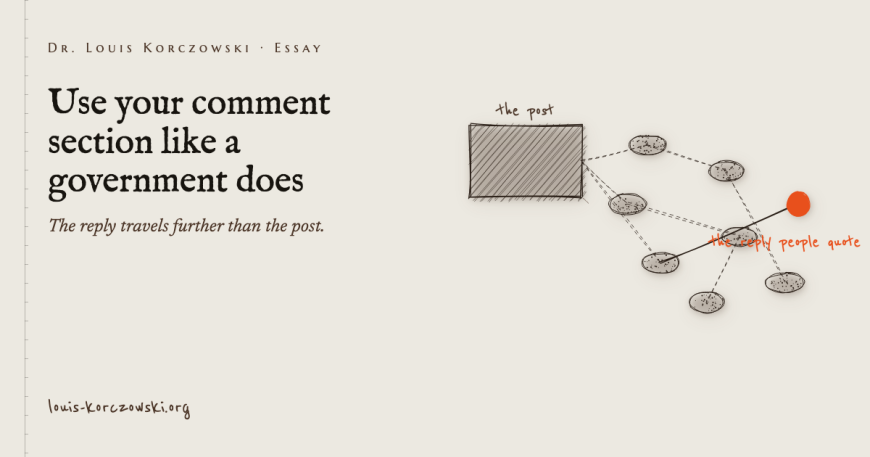
The scene is strong because every man watching it shares the same understanding: we do stupid things to seduce. The comment is stronger because it says it out loud, with a real piano and a real cancelled order, and thousands of men laughed because they knew they could have been that guy. Honestly, this clip sells pianos better than it sells the movie.
I am a PhD in machine learning and neuroscience, and I build short-form content for founders. Marketers still underrate what this shows: the comment section often spreads an idea faster than the content itself. Governments learned it years ago, and Russia runs some of the largest comment operations ever documented. Here is why it works, where the line is, and how a founder can use it without becoming a bot farm.
TL;DR
- The comment section is where viewers check what the crowd thinks. Sometimes it becomes the real show.
- One early up-vote measurably shifts how the next readers judge a comment. Crowds herd.
- State influence operations use fake comment armies at scale, and most of them fail to reach real communities. The shared feeling cannot be faked.
- A comment trap is content designed so that the comment section carries the idea: a deliberate mistake, a knowledge gap, or a bait aimed at your audience’s nemesis.
- Engagement bait begs for an action and gets demoted. A comment trap invites a reaction to an idea.
- To use it: design each piece of content with a comment trap, write comments that carry your idea under your own name, and give your community a private joke.
Why people read the comments before they think
TikTok does not publish how many viewers open the comments, but what it does publish says a lot. In an April 2024 survey of 1,150 TikTok users in the US, the UK and Canada, run for TikTok Marketing Science, 74% said the comment section is a way for brands to answer customers’ questions (TikTok, What’s Next 2024), and 68% said brands should use it to understand their consumers (TikTok, What’s Next 2025). At LMU Munich, Luise Anter and Anna Sophie Kümpel followed 46 young adults for a week with a diary study: when they wanted to check whether something on TikTok was true beyond their own intuition, they mostly went to the comment section (Anter and Kümpel, 2026). The comments are where the crowd checks the video, and your thumb goes there after three seconds to see what everybody else saw.
The platforms know it. TikTok now places search suggestions at the top of the comment section, and its own Creator Academy says these suggestions are generated in part from the comments under the video and from what viewers search after watching (Annabell et al., 2025). In other words, the comments write the search bar. An idea planted in the comments can become the keyword that the next million viewers click on.
Sometimes the comment section takes over completely. A mother who adopted children with special needs filmed a long drive with ten of them during a power outage. The video is simple, almost ordinary, and it passed 5 million likes. Under it, the most liked comment collected more than 518,000 likes, about one like for every ten likes on the video itself, and it is an inside joke that has nothing to do with the family. Some of that humor is cruel, and I will come back to the dark side. What matters here is the mechanism: thousands of strangers recognized the same reference at the same moment, and that shared recognition traveled further than the video.
The private joke is the real product
Robert Provine, a neuroscientist who spent decades studying laughter, found that people laugh about 30 times more often in company than alone, and that only 10 to 20% of the laughs he observed followed anything that looked like a joke (Psychology Today). Laughter is a signal sent to other people: I am with you, I got it too.
That is why the best jokes feel like a private joke with the rest of humanity, and the comment section is the room where that private joke happens at scale. It satisfies a very old need: to be understood and to belong.
I have said it before: social media has become an idea network, where people are linked by their interests instead of their friends (I explain the switch here). In an idea network, the power of an idea depends on its substrate, i.e. the shared references that make it land. The comment section is where you can see that substrate, and where you can engineer it.
I train this muscle every day. I spend a lot of time commenting under other people’s videos, and several of my comments collected thousands of likes. A few of them did a “ratio”: more likes on my comment than on the video I commented on. That experience taught me that one comment can flip the meaning of a whole video, for the worst or for the best.
Do comments really change what people think?
In 2013, Lev Muchnik, Sinan Aral and Sean Taylor ran a randomized experiment on a news aggregation site that works like Reddit. They gave 101,281 comments a random up-vote, a random down-vote or nothing, and watched for five months. A comment that received one artificial up-vote was 32% more likely to receive a positive rating from the next viewer, and it ended up with a 25% higher average score (MIT News).
The same study gives the steelman. Artificial down-votes were largely corrected by the crowd, which pushed back with positive votes. Researchers at the University of Wisconsin found a related effect on opinion itself: readers exposed to rude comments under a science article about nanotechnology ended up with more polarized views of its risks, split along what they already believed (Anderson et al., 2014). So comments rarely convert anybody, but they amplify what the crowd already feels and tell the undecided where the crowd stands.
Governments learned it first, and most of their armies fail
There is a much less funny use of the comment section. During elections, state actors deploy armies of fake accounts. They take a politician’s video and flood it with doubt, or they take a deeply unpopular leader and flood his videos with love. The goal is to manufacture the feeling that “everybody thinks this”.
In August 2023, Meta took down Spamouflage, a China-linked network, and Doppelganger, a Russia-linked operation. About Spamouflage, Meta wrote that it had found no evidence of the network getting any substantial engagement among authentic communities (The Register).
Russia is the case everybody has in mind. Meta called Doppelganger “the largest and most aggressively persistent covert influence operation from Russia” it had seen since 2017 (The Register). In September 2024, the US Justice Department seized 32 of its domains and stated that the companies behind it operated “under the direction and control of the Russian Presidential Administration” (US Department of Justice). Its fake profiles posed as American and other non-Russian citizens and left comments that pointed to fake news sites. The results are thin. Its fake Washington Post article, built on a fabricated Zelensky video, got no engagement on Meta. And when researchers measured the Internet Research Agency, the St. Petersburg troll factory of the 2016 US election, they found that 1% of Twitter users received 70% of its exposures, mostly people who were already strong partisans, with no measurable change in attitudes, polarization or voting (Eady et al., Nature Communications, 2023). The authors warn that this does not clear the rest of the campaign.
This is the most interesting finding for a founder. The largest known comment army in the world bought volume and failed to buy belonging. Fake accounts can produce numbers, and the shared substrate, the private joke that real people recognize, stays out of their reach. The comment that travels is the one a real person writes because he truly feels it. So copy what the Kremlin understood, that comments tell the undecided where the crowd stands, and leave the fake accounts to them. Voilà, this is good news for anyone with a real idea and a real community.
What is a comment trap?
When you create content as an entrepreneur, there is a format I call the comment trap. The goal is to use simple tools of mass psychology so that comments appear almost automatically, and so that those comments carry your idea further than your video.
The lightest version is the deliberate mistake. Ward Cunningham, the inventor of the wiki, is credited with a famous law: the best way to get the right answer on the internet is to post the wrong one. The funny part is that Cunningham himself disputes the quote, and the misquote spread anyway, which proves the law (jacob.blog). In a 2016 survey by the Engaging News Project, correcting inaccuracies came out among the top reasons people leave a comment (Nieman Lab). I am a strategist and a content creator, and nobody hires me for my spelling. So I can leave a spelling mistake in a text box, and somebody will feel obliged to fix it. Use this only when the mistake does not hurt your authority: a typo in a hook, yes, a wrong number in your pricing, never.
That version has little depth. The deeper version is built on the psychology of the exact people you want to reach, and its best weapon is the nemesis.
When I build an audience for a client, I define the ideal customer, of course. I also always define the nemesis: the person we never want. If they asked to buy our services, we would refuse them immediately, because they disagree with our whole approach.
The trap distills, inside the content, an automatic call to that nemesis. When the nemesis comments, two things happen. First, our community, the people who agree with us, feel obliged to answer and defend the position, because they are a group. Second, because it is a trap, the nemesis walks into a rhetorical dead end where their position is very weak and almost impossible to defend.
The halal charcuterie trap
Here is a trap I designed with Tonton Giovanni, a client I have worked with since early 2024. Giovanni ran a 25-seat pizzeria in Grenoble, and the restaurant was halal. For a large part of his customers, Muslim families, this was the reason to come: a pizza they can eat without asking questions.
Every time we tried to educate on the topic, an army of comments arrived to say that halal and Italian cuisine were incompatible, often from people who were not Italian themselves.
So we stopped arguing. Giovanni recorded a reaction to a video of someone tasting halal charcuterie, and he played the role of our nemesis. For more than a minute he gets angry: Italian charcuterie cannot be halal, this is impossible, next they will put halal charcuterie on pizzas! At the very end, holding the camera, I discreetly show the halal sign on the front of his own restaurant.
It worked at full power, for two reasons. The video was funny on its own. And the comment section became the second joke. People who left before the end commented in agreement with angry Giovanni, and the community answered them, laughing. The nemesis exposed himself, and the community felt more united than any educational video had made it feel. Several commenters even pointed out the people who commented before finishing the video, which is exactly the private joke at work.
Formats like this one are part of why Giovanni went from 2,000 to 1 million followers in two years, and 1.6 million today.
Comment trap or engagement bait? Where platforms draw the line
Ok, I know the objection. Is this engagement bait with a PhD? The platforms have punished engagement bait since December 2017, when Facebook started demoting posts that beg for reactions, e.g. “LIKE this if you’re an Aries!”, later extending the demotion to comments and to bait spoken in videos (Meta).
The difference is in what you ask for. Engagement bait asks for an action: like, comment, tag a friend. The viewer gives a mechanical reaction and leaves with nothing. A comment trap asks for nothing. It places a tension inside an idea, and the viewer comments because he has something to say about that idea. The algorithm reads the first as manipulation and the second as conversation, because that is what each one is.
The test I use: if every comment under the video is about your idea, it is a trap. If every comment is “yes” or a tagged friend, it is bait, and you deserve the demotion.
Here is an experiment I want founders to try. Next time you record a demo of your product, skip the classic “comment DEMO to get the link”. Show the result and keep the name of the tool to yourself. If your feature is really good, people will get frustrated and ask in the comments what tool you used, with far more motivation than if you had begged for the comment. Each of those questions is a viewer telling the algorithm, and everybody reading the comments, that your product is worth looking for.
How to use comments as a powerful tool for your ideas
Here is the handbook I give to the founders I work with. Three moves, from the content you publish to the community that carries it. The five trap patterns I use most are in the founder version of this method on statur.co, and my open-source Content Strategist AI Cookbook gives your AI the skills to apply the Creative-Led Growth method.
1. Design every piece of content with a comment trap
Before you publish, ask where the comment will come from. A knowledge gap, a deliberate mistake, a role reversal, a hidden product name, a belief of your nemesis said with conviction: your imagination has no limit here, and every option uses the same mass psychology. Then train your eye. When a comment explodes under somebody else’s video, ask yourself why this comment appeared under this video. That question, asked every day, is the whole training.
2. Write comments yourself, and make them carry an idea
Brands already comment, mostly for fun. In 2021, about a hundred brands piled into the comments of a viral broccoli video, and the top comment, from Holiday Inn Express, collected 1.1 million likes (OMR). Most of those comments are flat: they rely on the idea that brands talking to each other is funny. We don’t care about that. As a founder, your comment must resonate with a deep idea you want to be associated with.
Imagine you sell an AI that removes useless meetings. You see a sketch mocking a meeting that should have been an email. You can comment “So true, this is why we exist.” And it will be f*cking boring. Find the line that makes people laugh first and remember your idea second, e.g. “We calculated it. This meeting cost $1,400 and produced one emoji.” The idea is yours, the joke belongs to the crowd.
Two rules. First, comment as yourself. In the United States, the FTC’s 2024 rule on fake reviews and testimonials bans reviews by company insiders that hide their material connection to the business, with civil penalties of more than $50,000 per violation (Davis Wright Tremaine). The safe habit is simple: your account says who you are, and your team says “I work there” when it talks about your product. Check with your lawyer for your case. Second, never fake a crowd. Spamouflage proved it: fake volume buys nothing.
3. Give your community a private joke
The strongest comment strategy is a community that comments for you. When you run a group of content creators who work with you, share guidelines, running gags and private jokes between you, so that every one of their comments reinforces the group.
In France, Regelegorila, one of the most influential film critics on TikTok, became famous by criticizing people whose favorite movie was Interstellar (RTBF). It became a meme for his whole community: whenever Interstellar is mentioned somewhere, someone comments his name. Every one of those comments spreads his idea, and his name, in places he never posted.
So here is my question for you. What does your nemesis believe, and what would happen if you said it, out loud, better than they do?
The video carries the idea to the crowd, and the comment section decides whether the crowd keeps it.
FAQ
What is a comment trap?
A comment trap is content designed so that viewers comment on its idea almost automatically, for example through a deliberate mistake, a knowledge gap, or a role reversal that invites the audience’s nemesis to comment and the community to answer.
Is a comment trap the same as engagement bait?
No. Engagement bait asks for an action such as “comment yes” and is demoted by platforms. A comment trap asks for nothing and creates a tension inside an idea, so the comments discuss that idea.
Do comments change people’s opinions?
They shift judgments more than opinions. A randomized study by Muchnik, Aral and Taylor found that one early up-vote made a comment 32% more likely to get a positive rating from the next reader. Rude comments tend to polarize what readers already believe.
Can a founder comment on other people’s videos?
Yes, from an account that clearly identifies them, with a comment that carries an idea they want to own. In the US, undisclosed reviews or testimonials by company insiders are banned by the FTC.
Annex: the comment trap video
The halal charcuterie reaction described above, as published on Tonton Giovanni’s account.
Dr. Louis Korczowski is a short-form content strategist for SaaS and AI founders, with a PhD in machine learning and neuroscience. He applies these ideas with founders at STATUR, the author of the Creative-Led Growth Handbook, and the maintainer of the open-source Content Strategist AI Cookbook.