One evening at the end of summer 2020, between two Covid curfews, I opened TikTok for the first time. After ten minutes I knew I was looking at the best game ever designed. My millennial friends laughed at me scrolling on the couch through teenagers doing dance challenges. Then the laughing turned into concern, the kind you show a friend who just bought crypto at the top. I saw something they did not see yet.
I am a PhD in machine learning and neuroscience. Since then, the method I built from that evening has generated 400M+ organic views for clients in two years (last count, January 2026). This essay is about where that method comes from: board games.
TL;DR
- I learned marketing by running a board game and role-playing festival, years before marketing was my job.
- TikTok is a slot machine for ideas: one lever, one random reward, played billions of times a day.
- In 2020, social media moved from a social network to an idea network. Anyone who decodes the code can reach you with zero followers.
- Each video format is a die. You cannot control a throw. You can choose your dice.
- Theory tells you which dice to keep. Giving the game a soul is still your job.
I learned marketing at a game festival
From 2008 to 2010, I was president of Les Joutes du Téméraire in Nancy. It is a free board game and role-playing festival run by engineering students for more than thirty years, still today one of the largest free game festivals in eastern France. At the time, board games were not cool yet. We had to fill a hall with strangers using a tiny budget and a lot of posters. That was my first marketing job, and nobody called it marketing.
I have always been obsessed with game theory. I once rewrote, from A to Z, the tabletop rules of a Fallout role-playing game. I never published them, out of fear of intellectual property. I did it because I believe mathematical rules create situations that are deeply human. A good rule set makes a table of friends laugh, betray each other and remember the evening ten years later. The math is invisible. The emotion is the product.
Why TikTok is a slot machine for ideas
When I opened TikTok, I recognized the design immediately. The team had simplified the math to its simplest possible form: the slot machine.
B.F. Skinner showed that a reward delivered after an unpredictable number of actions produces the most persistent behavior. Psychologist Mike Brooks calls the smartphone version the Vegas effect: every refresh might contain something new, so we keep checking. TikTok succeeded in removing every confounding factor of human behavior and reduced it to a boolean, so the algorithm could compress our animal brain into the simplest prediction there is: will you swipe or not.
The neuroscientist inside me was thrilled at the elegance of the experimental design.
From a social network to an idea network
That same month, Eugene Wei published TikTok and the Sorting Hat, dated August 4, 2020. His point: TikTok learns what you like from what you watch, and skips your friend list entirely. Instagram Reels had launched worldwide on August 5, 2020, a copy that was only weeks old.
That evening I understood that humanity was switching from a social network, where people are linked by who they know, to an idea network, where people are linked by their interests and their personality.
I also saw the danger, and I felt the fear. In an idea network, anyone who can hack your interest can enter your feed, even with zero followers. They just need to decode the code.
The same machine that can spread a great idea can spread a dumb one faster. Voilà. That fear never left me, and it explains why I care so much about who learns to play this game.
My first throws were embarrassing
It took me a few years to understand the game, and to dare to play it. My first TikTok was shot in a bar, during an entrepreneurs’ evening. I am not proud of it. My second was shot at an evening with business angels. I asked their managing director to take part, he took it as a joke, and we became friends. The videos were bad. The experiment was cheap. I was learning the rules.
The day I had to bet the growth of a company on it
Then I joined Pixminds, a French gaming hardware company now called Lexip, to crack its direct-to-consumer acquisition. It was the opportunity I had waited for, and the fear of failing in public.
An agency had taken almost the whole budget. Two months later, sales had barely moved. I was facing a board with very experienced industry veterans. One Sunday night, I received an email written entirely in capital letters. Sorry to be blunt: it read like a declaration of war.
So I bet on what I had only tested for fun. I designed a format around what I knew of the game, and shot it myself. The first video passed one million views. Sales on the site started again. Funny detail: the video is still online today, even though everyone has lost access to the account.
For the next two months I tested everything. I have never stopped since.
A die is a format
Here is the essence of the theory. I will keep it pure. This is a theory essay, and the handbook lives elsewhere.
A video is a throw. You cannot control a single throw. The platform, the hour, the mood of the crowd, a news event: too many forces act on it. Most people stop here and call it luck.
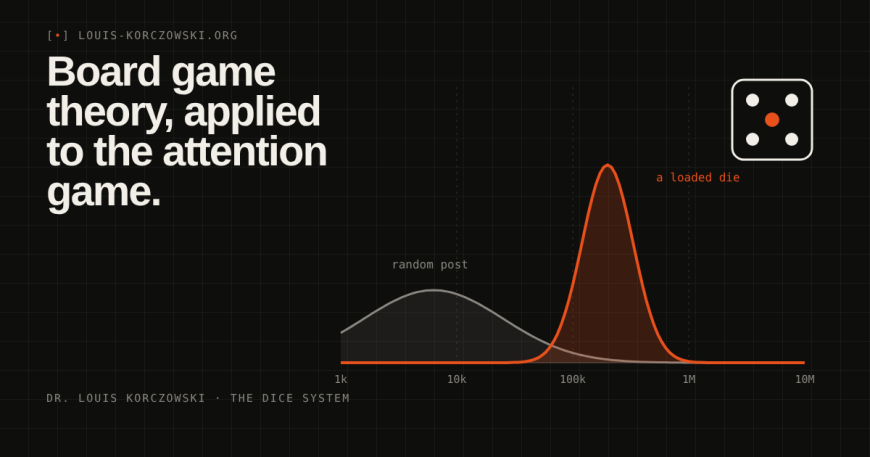
A format is the die you throw. A die has faces, and each face is a possible outcome. Some dice have a high average and a small spread: thrown ten times, they land in the same range. Others have a low average and one magic face that sometimes explodes. In the language of statistics:
Format quality = the highest expected views, E[views], with the smallest possible variance, Var[views].
Three consequences follow, and they are the whole method.
- Volume is how you read the die. One throw tells you nothing. Ten throws start to show its shape.
- You build a set of dice. Mimetic dice copy what already works on the platform. Original dice are carved around one person, their face and their way of talking. You need both.
- Persevere or kill. Data shows which dice land high and tight. Those become templates. The others get reshaped or retired. That judgment is the craft.
A board game designer works exactly like this. You playtest, you read the distribution of outcomes, you remove the rule that makes the game boring, and you keep the one that creates stories.
Testing the limits of the model
After Pixminds I tested the model with clients in dozens of sectors, to find where it breaks. Gaming hardware, signs, nutrition, a design fan, software.
The pizzeria next to my place was already posting videos. Nothing took off. The owner believed the secret was hashtags. We had a coffee. I pitched my idea, I gave him a price, he said yes. Two years later, he is an international star with his own show on national TV. All of that because of my passion for board games.
What the theory will not do for you
Theory tells you how to optimize a game. It does not design the game, and it does not give it a soul. You still need the idea worth throwing, the person who carries it, and the work of making every throw better than the last one.
So here is my question for you. If you had to describe your best idea as a die, how many faces would it have, and which one would you want to land every week?
The platforms are a game, and the best players are the ones who read the dice.
FAQ
What is the dice system?
A method to design short-form video formats. Each format is treated as a die thrown every week. The goal is the highest average result with the smallest spread, and data decides which formats become templates.
Why compare TikTok to a slot machine?
Because it uses a variable reward: each swipe might show something great, at unpredictable intervals. Skinner showed that this schedule produces the most persistent behavior.
Can game theory really help with marketing?
Yes. A content strategy is a repeated game with uncertain outcomes. Thinking in distributions instead of single results is what turns luck into a method.
Who is Louis Korczowski?
Dr. Louis Korczowski is a short-form content strategist for SaaS and AI founders, with a PhD in machine learning and neuroscience.
Dr. Louis Korczowski is a short-form content strategist and the founder of STATUR, where the dice system is applied with SaaS and AI founders.