I have a PhD in AI. What is happening to us right now gave me a big existential crisis. So big that I changed career.
I first shared this reasoning with my community. Some of the discussions we had were better than my own arguments, so I will come back to the best ones later in this article.
If you build in tech, here is my reading grid for what comes next. It is long. Voilà.
The short version
- The experts who call LLMs a dead end judge AI with mental software built before 2022.
- For business, the intelligence debate is secondary. Adoption is the fact: 900 million people use ChatGPT every week.
- Money becomes chips and energy. Chips and energy become intelligence.
- That intelligence will be abundant, and concentrated in very few hands.
- When building gets cheap, attention and trust become the scarce goods. Trust attaches to people. That is why I moved to marketing in 2022.
The experts are probably wrong about AI. I was one of them.
In the research world I come from, the consensus is reassuring. Yann LeCun is its most famous voice. He calls LLMs a dead end on the road to human-level intelligence, and he left Meta after twelve years to build “world models” at his own startup, AMI Labs (The Decoder).
To be fair, the field is split. Geoffrey Hinton and Yoshua Bengio signed the 2023 Statement on AI Risk, next to pandemics and nuclear war. But the reflex I grew up with in European labs is the reassuring one: “Yes, something is happening. It will fall back down.”
I think they miss the point.
Four years ago, in 2022, outside of research labs, nobody talked about LLMs. We talked about machine learning. And the software in the experts’ heads was installed during that era. It has barely been updated.
Petite anecdote. The first neural networks that really worked in production read handwritten digits, i.e. zip codes for the post and checks for the banks. That was LeCun’s own work, around 1990. Then for twenty years, outside a few narrow tasks, neural networks stayed a curiosity. If you lived those twenty years, “it will fall back down” is a very reasonable bet.
It is also the wrong bet.
Intelligence is emergent
My PhD was applied mathematics for neuroscience. The first thing neuroscience teaches you is humility: intelligence is emergent.
An artificial neuron is a very simple object. A mathematical function, with a small non-linearity inside. We call it a neuron because it behaves a bit like ours. Put enough of them in series, train them, and they learn things nobody wrote in the code.
So nobody can tell you what will emerge from the models we train today. Me neither. We discover the structure of an intelligence after it emerges.
We had a whole mythology around human intelligence, something almost divine. Then we found neurons: basic functions, working in synergy. We also took centuries to accept that animals have emotions. I suspect we will be just as slow to recognize what emerges in machines.
Forget the intelligence debate. Look at adoption.
Super intelligence, average intelligence, stupid intelligence. For business, honestly, we don’t care. There is one societal fact: everybody uses AI.
OpenAI announced 900 million weekly ChatGPT users in February 2026 (TechCrunch). Three years and three months after launch.
I saw the “before”. A few years before ChatGPT, I was in a startup hosted in Grenoble that worked with GPT-2, the ancestor. Its capabilities were very limited. There was no universal language: we had one model per language. I wanted to use it to help people with medical problems. For the researchers around me, that was science fiction. Surreal. A few small experiments, very little ambition.
Then ChatGPT came out in November 2022. Even LeCun said at the time it was “not particularly innovative” on the technical side (NYU Tandon). He was right about the technology. En fait, the revolution was the usage.
Money becomes matter. Matter becomes intelligence.
Since then, we pour money. Huge amounts. Here is what the money does:
- It becomes matter: chips, the substrate of computation.
- It becomes energy, to run the chips.
- Substrate plus energy equals a form of intelligence. At a scale we have never seen.
Epoch AI measured it: the training compute of frontier models grew about 4 to 5x per year between 2010 and 2024 (Epoch AI). Richard Sutton wrote the theory in 2019, in a short essay called The Bitter Lesson: in AI, the general methods that use more computation win, again and again (e.g. search and learning).
Ok, I know. This is getting long. Stay with me, here is what to conclude.
Intelligence will be abundant. And concentrated.
For me, the super intelligence question is secondary. The important word is abundant. And this abundant intelligence will be distributed very differently from human intelligence.
Human intelligence follows a bell curve. Great intelligence is rare, like great stupidity. Sorry to be blunt, with my French accent it sounds even worse.
In a human society, gathering very smart people is hard. When it happens, Google, Facebook, the whole Silicon Valley machine built to densify talent, what does that intelligence solve? Business problems at scale. Sometimes clearly Kafkaesque ones. You look at it and you ask: what are they really trying to do?
Some people hope AI will spread intelligence more evenly across the population. I think AI will concentrate much more intelligence in a small number of hands. Everyone will get access to an average intelligence, i.e. a very good assistant. The problems that need real intelligence will be solved by the people who own the data centers.
And AI is cheap today. Prices can rise any time. Running a frontier model at home is impossible today: the best you get locally is a much smaller open model.
I am describing the basic scenario. Maybe one day there is a super intelligence we struggle to even understand. I leave that one aside. The basic scenario is enough: intelligence, massively assembled inside a few companies.
What this means if you build something
You are a founder. Or a researcher. You have an idea in your head, something complicated and ambitious.
Here is the problem. If you had this idea, other people had it too. The moment you share it, you take a risk: someone launches thousands of agents on it. A lot of energy converted into intelligence, even weaker than yours, to solve exactly your problem.
Building a SaaS used to take months, sometimes years. Today it takes a few weeks. Tomorrow, a few hours.
So you now compete with anyone who has more compute than you. And you hope they stay busy with juicier problems. What is left for you is the set of problems too small to interest them. That is thin ground to build a company on.
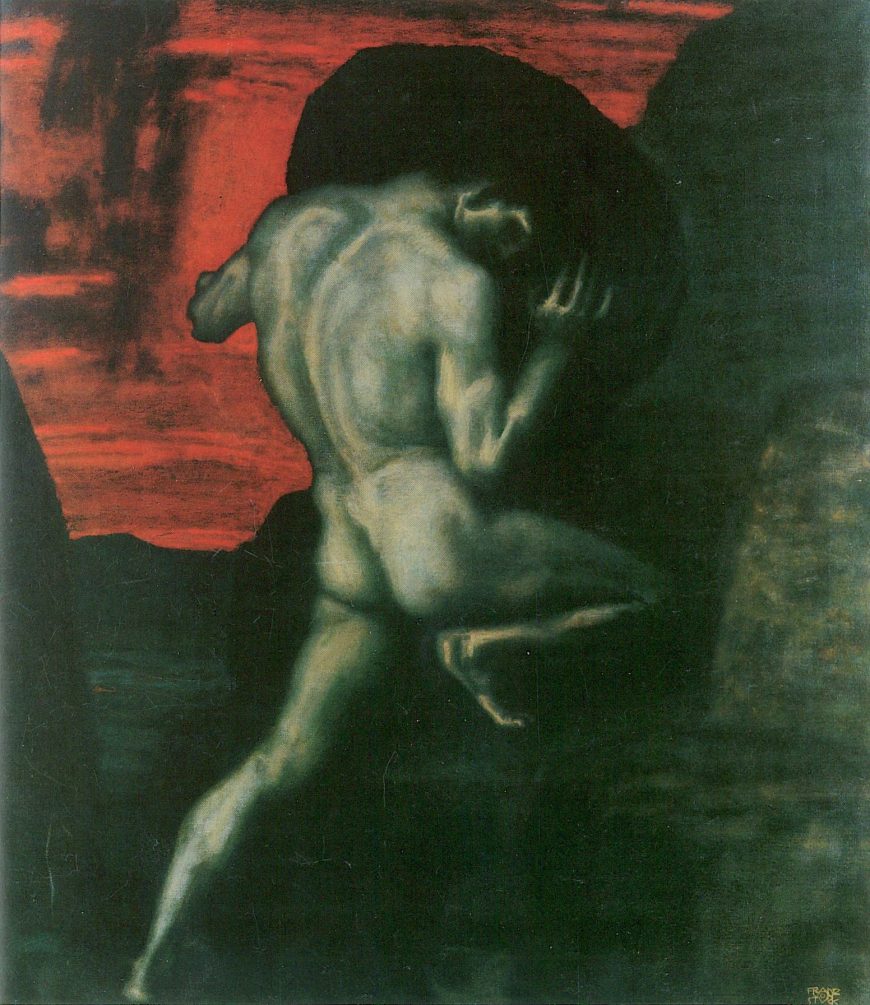
Building a product against whoever owns the most compute is the work of Sisyphus. You push the rock up, someone with a thousand agents rolls it back down.
Same in research. Pharmacology and every complex field (e.g. drug discovery, materials) will be mostly authored by AI, supervised by humans.
I was already asking this in 2023, in Should I start an AI startup during the ChatGPT hype? and The Business Model of AI Startups. The answer got sharper since.
What can AI never reproduce?
Back to my path. In 2022 I asked myself one question. Making a successful product was already hard. Now the competition becomes impossible. So what will remain that AI can never reproduce, smart or dumb, at any scale?
My answer was marketing.
Marketing works on mass psychology. AI can understand mass psychology, d’accord. But a human has to stay in the loop: someone who stands in front of the audience and answers for the message.
In one of my videos I said humans will get better and better at detecting what AI made. Here I correct myself, because the research says the opposite. In a 2023 study published in PNAS, people identified AI-written texts at about 50% accuracy (Jakesch, Hancock and Naaman). A coin flip. C’est la vie.
So detection is a weak moat. Provenance is a strong one, i.e. who stands behind the message. A face. A voice. A name that takes responsibility. A track record people can check.
Herbert Simon saw it coming in 1971: “a wealth of information creates a poverty of attention.” When intelligence is abundant, attention and trust become the scarce goods. And trust attaches to people.
Et voilà, that is why today I work with founders on camera. Their product can be copied in a weekend. Their ideas, their face and their judgment take years to copy.
“A PhD in AI to end up a marketer”
When I shared this reasoning with my community, the most liked reaction was exactly this one: “A PhD in AI to end up a marketer.” Fair.
David Ogilvy, the father of modern advertising, also came from research. He measured audiences for George Gallup before he wrote a single ad (Wikipedia). He also wrote: “The consumer isn’t a moron; she is your wife.” For me, that sentence is the whole job. Respect the audience. Understand it. Answer to it. Machines produce content at infinite scale. Respect and accountability stay human work.
Other people in the discussion said it better than me. An engineer told me he spent 30 years in industrial automation. His machines let one person run five machines, each one producing as much as ten people. His work led to layoffs in his own workshop. He had his existential crisis too. Today he farms fish.
Another one asked the real question: will we automate humans to fit processes, or automate processes to give humans back their place?
If you want the raw version, here is the 10-minute unedited video where it all started, and where the discussion continues:
Since I made that choice, the content strategies I ran for clients generated more than 400 million organic views in two years (last count January 2026). Camus said we must imagine Sisyphus happy. I found my way to be happy: I stopped pushing the product rock and started working on what people remember.
Bref. What will AI never reproduce? Someone answered food. Someone else, manual trades. Someone else, selling. Mine is marketing.
Win the idea market before the product market. The product market now belongs to whoever owns the most compute.
FAQ
Why did Louis Korczowski leave AI research?
Because he expects AI to make intelligence abundant and concentrated in the hands of whoever owns the compute. Building products becomes a race against better-funded players. He moved to marketing in 2022, where trust, attention and human accountability stay scarce.
What can AI not replace?
His answer is marketing: winning the attention and the trust of an audience. AI produces content at scale, and people trust a face, a voice and a name that takes responsibility.
Can people detect AI-generated content?
Poorly. A 2023 PNAS study found people identify AI-written self-presentations at about 50% accuracy, chance level. Provenance (who stands behind a message) matters more than detection.
What is the moat of an AI startup when anyone can build the product?
Distribution and trust. Founders who own their ideas in public, on camera, build an audience that competitors cannot copy as fast as they copy the product.
How this was written: the ideas, the stories and the opinions are mine, first spoken in one take to my community. I used Claude (Anthropic) to structure the text, clean my English and fact-check my own claims, e.g. the PNAS correction above. The mistakes that remain are mine.
Dr Louis Korczowski has a PhD in AI and neuroscience and spent ten years in brain-computer interface research before moving to marketing. He now helps SaaS and AI founders win the idea market before the product market at STATUR.