On 22 October 2026, Andrew Yeung, a former Google and Facebook employee (profile) who now runs Andrew’s Tech Events, which drew about 25,000 people to 75 events in 2025 (Andrew’s Tech Events), posted a short video with a claim that made a lot of founders nervous. When a startup launches on X and gets a million views in a few hours, it is often bought. An agency lines up hundreds of accounts, influencers and anonymous profiles, and they all quote-repost the launch at the same time. The algorithm reads a crowd, pushes the post, and the startup takes over the timeline for a day (his video). He calls it the Underground Distribution Network.
I have spent years engineering distribution for founders, and I read this with two reactions at once. He is right about the mechanism. He is wrong about the word “underground”. And the question that matters for a founder is one his video leaves open: what exactly do you own on day two?
TL;DR
- The playbook is real and openly sold. Agencies such as Doomers, LaunchVideo.com, Clickstrike, Flowjam and GrowthMatrix sell timed posting by creator and founder accounts, some with guaranteed view tiers. a16z offers “launches as a service” to its own portfolio.
- It works for a reason a neuroscientist can explain: crowds herd, and analyses of X’s ranking code say the first 15 to 30 minutes weigh heavily on how far a post travels.
- The window is short. The median half-life of a tweet is about 80 minutes, and the best-documented viral launches (Cluely, Friend) bought attention long before they had a business to show for it.
- Paying for reposts breaks X’s own rules. Paid creator posts need X’s Paid Partnership label, and the FTC bans knowingly buying fake followers and views.
- Use the launch as a match. The fire is a founder who keeps saying something worth reposting after day one.
How startups buy a viral launch on X
Let’s start by taking the mystery out.
The vendors’ own descriptions follow the same sequence. The founder posts first, usually a cinematic launch video, often with a request for replies. Within the first one to two hours, a pre-briefed batch of accounts reposts and, above all, quote-posts it. One agency, Doomers, says it works from a seed list of 80 to 100 accounts per launch and sells one company per weekday (Doomers guide, press release). GrowthMatrix tells clients to post on a weekday morning, US time, so both coasts and Europe are awake, and to follow on LinkedIn one or two days later (GrowthMatrix).
There is nothing underground about the prices either. Flowjam publishes its own: about $20,000 for the launch film alone, then $30,000 to $50,000 tiers that add guaranteed views (Flowjam). LaunchVideo.com, run by Atomik Growth, puts “1M, 3M, or 5M views” guarantees on its homepage (LaunchVideo.com). Clickstrike starts at $25,000 per launch and quotes the X amplification separately (Clickstrike).
And the most famous venture firm in the Valley does it in-house. a16z’s new media team describes its offer as helping founders “win the internet for a day”, with a house account of about a million followers to guarantee distribution (a16z, a16z, 2026).
Yeung’s other details, the very young operators and the agencies based in India, I could not confirm in any source. Some of these companies have international teams. That proves nothing, so I leave it there.
The real correction is the word. A playbook that a16z sells on its website is the mainstream. What stays hidden is the label on each repost, and we will come back to that.
Why it works: herding plus a ranker in a hurry
Here my old job is useful. For ten years I measured brains, and the most robust thing I learned is that humans decide what is good partly by looking at what other humans already decided.
Lev Muchnik, Sinan Aral and Sean Taylor tested it on a real social news site. They gave random comments a single fake up-vote at birth. The next reader was 32% more likely to up-vote too, and those comments ended with ratings 25% higher on average (Science, 2013, Taylor). Matthew Salganik’s MusicLab found the crowd effect at scale with 14,341 people downloading songs: once people could see download counts, the winners became bigger and much less predictable (Salganik, Dodds and Watts, 2006).
Now add the machine. X ranks the For You feed with a model adapted from Grok, whose code was published in January 2026 (PPC Land). Analyses of that code say a post needs replies, clicks and dwell time in roughly its first 15 to 30 minutes to reach the wider pool. That window is a third-party estimate, so treat it as a strong hint.
The code even tells you what a quote is worth. In the scoring weights X published in August 2026, a predicted quote or reply counts 5, a repost 1 and a like 0.66, while a predicted mute counts minus 58.8 and a report minus 234 (xai-org/x-algorithm). Each quote is also a new post shown to the quoter’s own followers. So a quote from an investor whose followers care about your space travels far, and a quote from an account whose followers tend to mute it barely travels at all.
Put the two together and you have the whole trick. A hundred accounts that quote-post in the same half hour tell the ranker and the human reader the same story: everybody is talking about this. Voilà. It is mass psychology with a scheduler.
Fake numbers persuade, so read the ratio
Here is the part founders underestimate, in both directions.
A bought crowd works on more people than we like to admit. A study in the Journal of Business Research found that big follower counts still impress people even when they know some of the followers are fake (Zhou et al., 2023). The number works on everyone, investors included. What a sophisticated reader adds is a ruler.
X counts every view by a logged-in user, including repeat views and the author’s own, so views are the easiest number to pad (X Help). Likes are harder. One vendor’s research on 30 launches, which uses this same ratio to sort them, found a median of about 1,441 views per like for launches it judged amplified, against about 354 for organic ones (FORKOFF). Treat it as a heuristic. A million views with a few hundred likes is a signature, and the investors you want to impress know how to divide. a16z itself criticizes launches with “engagement metrics that don’t pass the smell test” (a16z, 2026).
The cleanest demonstration came from inside the industry. Arthur Zargaryan, who runs LaunchVideo.com, launched a fake startup called Sliceline.ai with a fake $6M round. Its video passed 700,000 views by the end of launch day, and he wrote that you can collect millions of views “that go absolutely nowhere” (his X article, via YouMind). D’accord, he sells launches, so the stunt is also an ad. The point still stands: views are the one part of a launch you can buy without a product.
How long a viral launch lasts
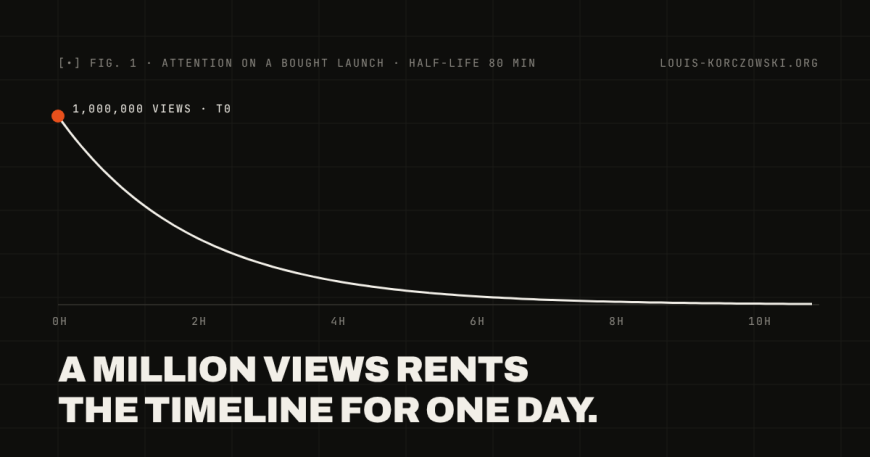
Attention on X has a clock. Jürgen Pfeffer and colleagues measured it: the median half-life of a tweet is about 80 minutes (arXiv, 2023). A launch day is a few half-lives stacked by a network, then the curve falls back to your real audience.
So what do you keep? Look at the two most documented viral launches of the last two years.
Cluely said it had 70,000 signups in its first week (TechCrunch), raised $5.3M, then $15M led by a16z. Its launch video passed 13 million views on X, and by July it was paying 700 clippers and more than 60 creators to post (SF Standard). In November 2025 its founder said “maybe we launched too early” (TechCrunch). In March 2026 he admitted that the $7M ARR he had given TechCrunch was false; the Stripe figures he posted showed $2.7M consumer plus $2.5M enterprise ARR, about $5.2M (TechCrunch).
Friend spent $1.8M on its domain (404 Media) and more than $1M on New York subway ads (TechCrunch), and its founder said he had “purchased the zeitgeist”. Fortune counted about 3,000 devices sold and about $348,000 of revenue (Fortune).
The larger data says the same thing more politely. A May 2026 study of 67,292 Product Hunt launches found that a #1 daily rank goes with about four times the Series A rate of a low rank (2.2% against 0.5% within 18 months), and still about 98% of #1 launches raised no Series A in that window (PHBench, arXiv). Grant Lee, co-founder and CEO of Gamma, won Product Hunt’s product of the day, week and month, watched signups plateau, and says the team nearly mistook the buzz for product-market fit (SaaStr). Gamma later reached $100M of ARR mostly on word of mouth, helped by a second launch tweet that went viral on its own merit.
A launch spike goes with success. Nothing in the data shows it causes it.
Is it allowed to pay for reposts on X?
Here the video skips the most important detail. Paying people to repost your launch breaks X’s own rules.
X’s platform manipulation policy bans “selling or purchasing followers or engagements”, reposts included, and its authenticity policy bans compensating others to inflate an account’s metrics (X platform manipulation policy, X authenticity policy). The penalties go from limited visibility to suspension. What X allows is coordinating with others to express ideas or support: your investors, customers and friends choosing to quote you, in their own words, for free. Coordination whose purpose is to inflate the numbers is banned even when unpaid. A creator paid to make their own sponsored post is a third case: X requires its Paid Partnership label (X paid partnerships policy), and the label discloses the payment without turning metric inflation into fair play.
US law adds two layers. A paid post is an endorsement under the FTC’s Endorsement Guides, and the payment must be disclosed clearly, in a way that is hard to miss (FTC). Since October 21, 2024, an FTC rule also bans buying or selling fake indicators of social media influence, such as followers or views generated by a bot or hijacked account, when the buyer knew or should have known they were fake and uses them for a commercial purpose. Knowing violators face civil penalties (FTC, Morgan Lewis). In France, the 2023 influencer law requires the words “publicité” or “collaboration commerciale” on paid promotion (Actu-Juridique).
Crypto ran this experiment first. In September 2025, the investigator ZachXBT published a list of more than 200 influencers approached for one token campaign at up to five figures per post; about 160 accepted and fewer than five labelled their posts as ads (The Block). The anonymous accounts in Yeung’s description, which no source I found confirms for startup launches, would be the riskiest part of this market. A friend who quotes you is distribution, a labelled creator post is an ad, and an army of paid anonymous profiles is a fake crowd.
The objection: “my launch only gets one shot”
When I share this with founders, the answer is always the same. Ok, I know: you have one launch, investors are watching, and a quiet launch looks like a dead startup. A bought spike at least gets you into the conversation. Lester Chen at a16z speedrun says a viral video can get you to the interview with investors, with no promise of the check (a16z speedrun).
I agree with that, and it is exactly why the launch should be the first die you throw. Nico Christie, a founder quoted in the same guide, put it better than I can: a launch is a weapon, and the goal is somewhere else.
The math makes the choice concrete. At the $27 CPM we use as our benchmark for a US AI and SaaS audience, one million impressions bought as Meta ads cost about $27,000. Flowjam’s 1M-view launch tier costs $50,000, film included. Both buy a day. A founder who has learned to package ideas buys every launch after this one. In two years we generated more than 400 million organic views for clients (last count January 2026), and none of the accounts that compounded got there with one spectacular day.
How to use a launch network without renting your reputation
If you launch on X in the next quarter, here is the playbook I give founders.
- Build your own network before you rent one. List 50 to 100 people who would sincerely repost you: investors, customers, founder friends, former colleagues. Founders in a16z speedrun’s launch guide call them champions. Brief them a week before with the time, the post and one sentence they can quote in their own words.
- Ask for quotes and replies. Quote posts carry a voice and travel further than plain reposts. Put the signup link in the first reply: analyses of X’s ranker suggest posts with external links get less reach.
- Put the founder on camera. The launch video sells the vision. A founder explaining the idea in under two minutes is a format you can repeat on day two, day ten and day one hundred. A cinematic film without you is a format you cannot repeat.
- Pay for creators, never for reposts. Paid reposts break X’s rules. If you hire creators, they make their own post with X’s Paid Partnership label, and the contract says so in writing. Refuse any offer built on anonymous accounts or guaranteed views from accounts nobody can name.
- Plan the four weeks after the launch. One vendor says most signups and follows arrive after the first day. Prepare the follow-up videos, the founder thread and the customer reactions before launch day, so the curve has something to land on.
- Judge the launch on signups and conversations. Views tell you what the ranker liked. Demos booked tell you what the market wanted.
So here is my question for you. If you removed every paid repost from your last launch, what would your timeline say about your company today?
A million views rents the timeline for a day; an idea worth repeating owns it for years.
FAQ
What is the “underground distribution network” for startup launches?
It is the practice of paying a network of creator and founder accounts to repost and quote-post a startup’s launch on X within the same short window, so the algorithm reads it as a viral moment. Several agencies sell it openly, some with guaranteed view tiers. Yeung also describes anonymous profiles, which no source I found confirms.
How much does a viral launch on X cost?
Public prices are rare. Flowjam lists about $20,000 for a launch film and $30,000 to $50,000 for packages with guaranteed views. Clickstrike starts at $25,000 per launch, with X amplification quoted separately. Most distribution agencies only quote on a call.
Is it allowed to pay accounts to repost your launch?
X’s rules ban buying reposts and paying others to inflate an account’s metrics. Paying a creator to make their own sponsored post is allowed with X’s Paid Partnership label. In the US, the FTC requires a clear disclosure of any paid endorsement and bans knowingly buying fake followers or views for a commercial purpose.
Does a viral launch help a startup raise money?
It can open doors. In a study of 67,292 Product Hunt launches, a #1 daily rank went with about four times the Series A rate of a low rank, yet about 98% of #1 launches did not raise a Series A within 18 months.
Annex: the original video
Andrew Yeung’s video that started this essay.
Dr. Louis Korczowski is a short-form content strategist with a PhD in AI and neuroscience. The full launch playbook, vendors, rules and launch-week plan are in the X launch playbook on STATUR.